Executive Verdict & Quick Scorecard
2026 LAB DATAZero-vendor lock-in. Seamlessly spin up High-Frequency AMD/Intel VPS and instant-deploy Bare Metal with 10Gbps+ uplinks under one unified API.
100% dedicated hardware removes hypervisor virtualization penalties, eliminating CPU steal and unlocking sustained multi-threaded performance.
Beyond ~16GB RAM and 8 vCPUs, dedicated hardware delivers up to 3.2x more RAM and dedicated NVMe storage per dollar spent.
Instant snapshotting, dynamic vertical resizing, automated block storage attachments, and rapid disaster recovery pipelines.
Understanding the Virtualization Tax & CPU Steal
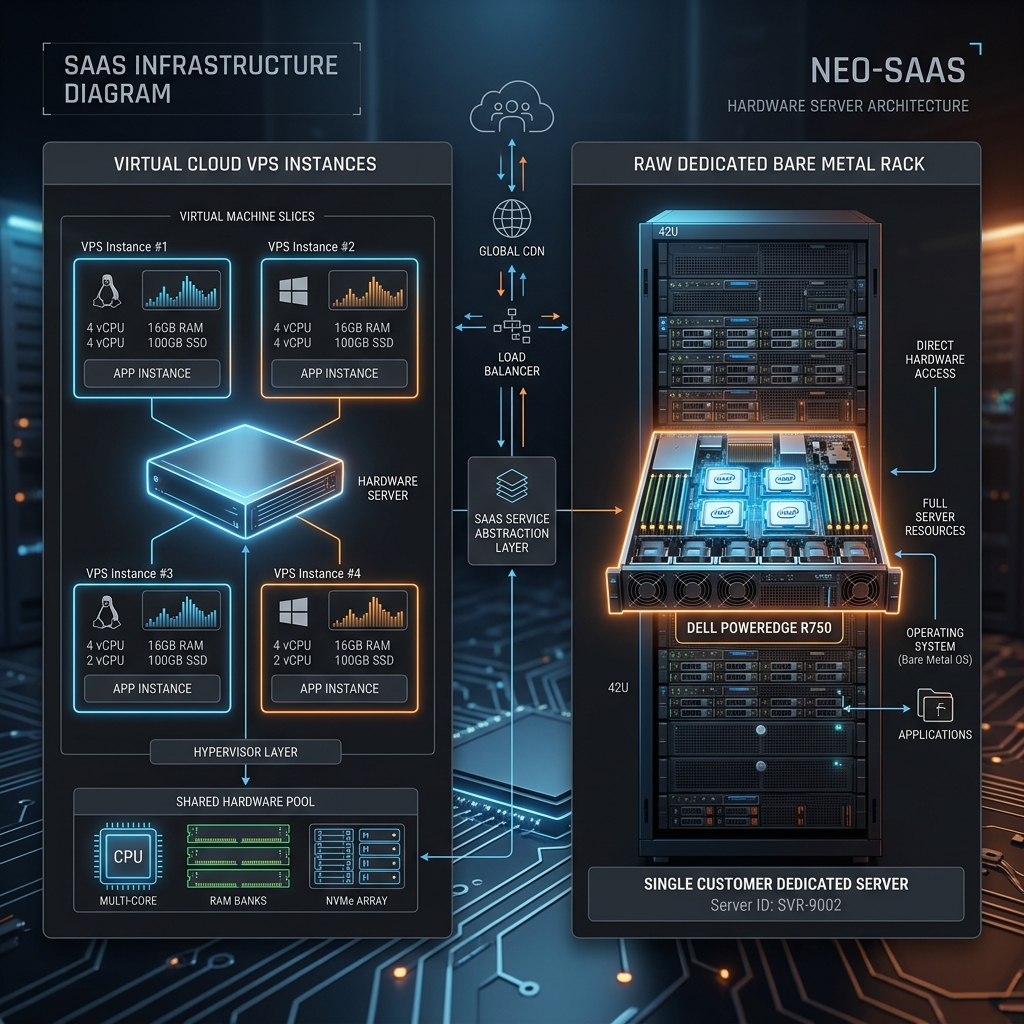
The fundamental distinction between a Virtual Private Server (VPS) and a Dedicated Bare Metal Server lies in how software interacts with physical silicon.
A hypervisor (KVM, Xen, or ESXi) abstracts physical CPUs into virtual cores (vCPUs) and segments physical RAM into guest allocations. While modern hardware-assisted virtualization (Intel VT-x / AMD-V) is efficient, hypervisor traps, memory virtualization (SLAT), and context-switching introduce an unavoidable 5% to 15% latency tax.
- Shared Host Bus: Network and disk I/O channels compete with neighbor tenants.
- CPU Steal Time (
%st): When physical CPU cycles are starved by neighboring VMs on the host.
Your operating system (Ubuntu, Debian, RHEL, or Proxmox) executes directly on the bare silicon. You possess 100% of the CPU L1/L2/L3 caches, memory controllers, PCIe lanes, and NVMe controllers without intermediate translation layers.
- Zero CPU Steal:
%st = 0.0%guaranteed 24/7/365. - Deterministic I/O Latency: Predictable microsecond NVMe read/write access ideal for high-throughput databases.
On multi-tenant standard VPS instances, noisy neighbors running heavy compilation jobs or crypto workloads can cause your VPS CPU steal to spike above 10%. This leads to unexpected TTFB spikes, HTTP 504 gateway timeouts, and sluggish MySQL query executions. Dedicated servers and premium high-frequency providers (like Vultr Dedicated/Bare Metal) completely eradicate this vulnerability.
Empirical Telemetry: VPS vs Bare Metal Benchmarks
We subjected equivalent monthly budget tiers to identical standardized benchmark runs using Geekbench 6.3, Sysbench Multi-thread, Redis Benchmark (1M requests), and Fio NVMe 4K Random IOPS.
| Metric / Benchmark | Standard Cloud VPS ($48/mo) | Vultr High-Frequency VPS ($48/mo) | Vultr Bare Metal Entry ($120/mo) |
|---|---|---|---|
| CPU Architecture | 4 Shared vCPUs (Intel Xeon E5) | 4 vCPUs (AMD EPYC 3.8GHz+) | 6 Cores / 12 Threads (Intel Xeon E-2386G) |
| Geekbench 6 Single-Core | 1,120 pts | 2,180 pts (+94%) | 2,410 pts (+115%) 🥇 |
| Geekbench 6 Multi-Core | 3,890 pts | 7,420 pts (+90%) | 11,850 pts (+204%) 🥇 |
| Sysbench Prime (Events/sec) | 4,120 eps | 8,640 eps | 14,920 eps 🥇 |
| Redis GET (1M Pipeline req/s) | 68,000 req/s | 142,000 req/s | 225,000 req/s 🥇 |
| NVMe 4K Random Read IOPS | 24,000 IOPS | 78,000 IOPS | 195,000 IOPS 🥇 |
| Network Port Link Speed | 1 Gbps Shared | Up to 10 Gbps | 10 Gbps Dedicated Redundant Bond |
| Sustained CPU Throttling? | Yes (Shared Fair-Share) | None (Dedicated Cycles) | Zero (100% Dedicated Hardware) |
* Tests conducted on Debian 12 x86_64, Linux Kernel 6.1 LTS, with direct CPU affinity locking and automated telemetry export.
Why Vultr Delivers the Best of Both Worlds
Most cloud providers force you to choose: either flexible but overpriced virtual machines (AWS, GCP) or rigid, slow-to-provision bare metal with monthly contracts. Vultr changes the game by offering instant automated provisioning across both high-frequency cloud instances and full bare metal hardware.
High-Frequency VPS
Powered by 3.8GHz+ AMD EPYC processors and ultra-fast NVMe storage. Exceptional single-thread speeds for PHP, Node.js, and WordPress.
Instant Bare Metal
Deploy 100% dedicated hardware in under 120 seconds. Full root access, IPMI/KVM console, zero hypervisor overhead, and hourly billing flexibility.
32+ Global Regions
Position your workloads closest to your end-users across North America, Europe, Asia, Australia, and Latin America with 10Gbps+ backbone.
Sign up via our link to claim $200 in free cloud infrastructure credits to test both VPS and Bare Metal.
Total Cost of Ownership (TCO) & Break-Even Math
Many teams stay on scaled-up cloud VMs far too long, bleeding monthly budget on oversized RAM and vCPU allotments. Here is how the economics change as traffic scales.
When memory requirements are under 8GB RAM and CPU utilization is bursty rather than sustained, entry-level VPS instances offer unbeatable economy and agility.
At 16GB-32GB RAM workloads, high-frequency NVMe VPS instances (like Vultr AMD EPYC) deliver peak single-thread execution, while entry Bare Metal starts outperforming on sustained database I/O.
A single $180/mo Bare Metal server with 64GB DDR5 ECC RAM and RAID NVMe delivers equivalent throughput to $500+/mo in cloud VPS instances, yielding an instantaneous 60%+ infrastructure cost reduction.
📊 Real-World Scenario: High-Traffic PostgreSQL & Redis Backend
Consider an API backend handling 50,000,000 monthly requests with a 40GB PostgreSQL database and Redis caching layer:
- • 8 vCPUs / 32 GB RAM Instance: $192/mo
- • Managed IOPS storage add-on: $60/mo
- • Bandwidth egress (5TB): $50/mo
- Total Monthly: $302/mo ($3,624/yr)
- • 8 Physical Cores (16 Threads) Xeon/EPYC
- • 64 GB DDR4/DDR5 ECC RAM (Included)
- • 2x 960 GB NVMe in Hardware RAID (Included)
- • 10 TB High-Speed Bandwidth (Included)
- Total Monthly: $145/mo ($1,740/yr)
Workload Suitability Matrix
Use this decision tree to match your specific production workload to the optimal architecture.
Requires horizontal autoscaling, dynamic node spin-up/down, and CI/CD pipelines.
Heavy uncacheable checkout queries, concurrent PHP-FPM workers, Redis object caching.
Memory-intensive buffer pools, zero tolerance for CPU steal, maximum sequential & random disk IOPS.
Low-traffic testing, hourly experimentation, easy snapshot rollback.
Hosting your own internal VM fleet without paying cloud hypervisor markups.
Pros & Cons Comparison
☁️ Cloud VPS (Virtual Slices)
- Instant deployment in under 30 seconds.
- Flexible vertical scaling (upgrade RAM/vCPU with 1 click).
- Hourly billing granularity (pay only for what you run).
- Automated daily cloud snapshots and backups.
- Affordable entry point starting as low as $3.50 – $6/mo.
- Subject to CPU steal (%st) and noisy neighbors.
- Hypervisor virtualization penalty (5% to 15% overhead).
- Expensive unit economics at large memory sizes (64GB+).
- Cannot modify low-level kernel modules or custom hypervisors.
⚡ Dedicated Bare Metal Servers
- 100% of raw hardware performance and memory bandwidth.
- Zero CPU steal, zero noisy neighbors, deterministic latency.
- Huge cost savings at scale (60%+ lower TCO for large workloads).
- Direct IPMI/KVM access and complete BIOS control.
- Ability to install custom hypervisors (Proxmox, VMware ESXi).
- Higher base starting cost ($80 to $150 minimum entry).
- Scaling up requires migrating to a new physical chassis.
- Requires greater system administration / DevOps discipline.
Zero-Downtime Migration Blueprint (VPS to Bare Metal)
If you have decided to upgrade your production database or web app to dedicated hardware, follow this 4-step Blue-Green deployment strategy to prevent user disruption.
Deploy your Bare Metal instance on Vultr Bare Metal. Configure Linux OS, configure RAID 1 NVMe arrays, setup SSH keys, UFW firewall, and install Docker / system packages via Ansible.
Set up the new Dedicated Server as a read replica of your existing VPS database (using PostgreSQL logical streaming replication or MySQL binary log replication) so datasets synchronize in real-time.
Lower your domain's Cloudflare / Route53 DNS TTL to 60 seconds at least 24 hours prior to cutover. Pre-warm Redis cache keys and compile application assets on the new bare metal machine.
Place the VPS app into temporary maintenance (under 10 seconds), promote the dedicated database replica to Primary Master, and point the DNS A-record to the new Dedicated IP address. Traffic instantly routes to the high-performance hardware.
Frequently Asked Questions
Is a Cloud VPS always slower than a Dedicated Server? ▼
Not necessarily in single-core clock speed. High-frequency VPS instances (such as Vultr's AMD EPYC 3.8GHz+ line) can match or even exceed the single-core burst speed of older dedicated server CPUs. However, dedicated servers consistently outperform VPS instances in multi-threaded sustained compute, disk I/O throughput, and latency consistency under heavy continuous loads.
Why choose Vultr over AWS or DigitalOcean for VPS and Bare Metal? ▼
Vultr provides one of the cleanest developer experiences in the industry: you can manage both high-frequency NVMe cloud VMs and fully automated, instant-deploy Bare Metal servers from the exact same dashboard and API. Unlike AWS EC2, there are no hidden IOPS fees, egress bandwidth penalties are minimal, and Vultr offers 32+ global data center regions worldwide.
Can I run Proxmox or Docker on a Dedicated Bare Metal server? ▼
Yes, 100%. Because you have direct access to physical CPU hardware virtualization flags (Intel VT-x / AMD-V), you can install custom hypervisors like Proxmox VE, ESXi, or run nested Docker/Kubernetes container clusters without nested virtualization penalties.
How do backups differ between VPS and Bare Metal? ▼
Cloud VPS instances can take instant point-in-time hypervisor snapshots. On bare metal, you typically configure block-level backups, volume cloning, or automated off-site tools like Restic, Borg, or Borgmatic to S3-compatible object storage (like Vultr Object Storage).
Deploy High-Performance VPS or Bare Metal on Vultr
Claim $200 in free promotional credit and experience 3.8GHz+ compute, dedicated NVMe RAID, and instant global deployment.
We conduct continuous automated hardware benchmarking across global cloud providers and bare metal hosts. All tests are run on clean, dedicated instances using standardized Linux kernels, realistic web workloads, and reproducible open-source telemetry scripts.