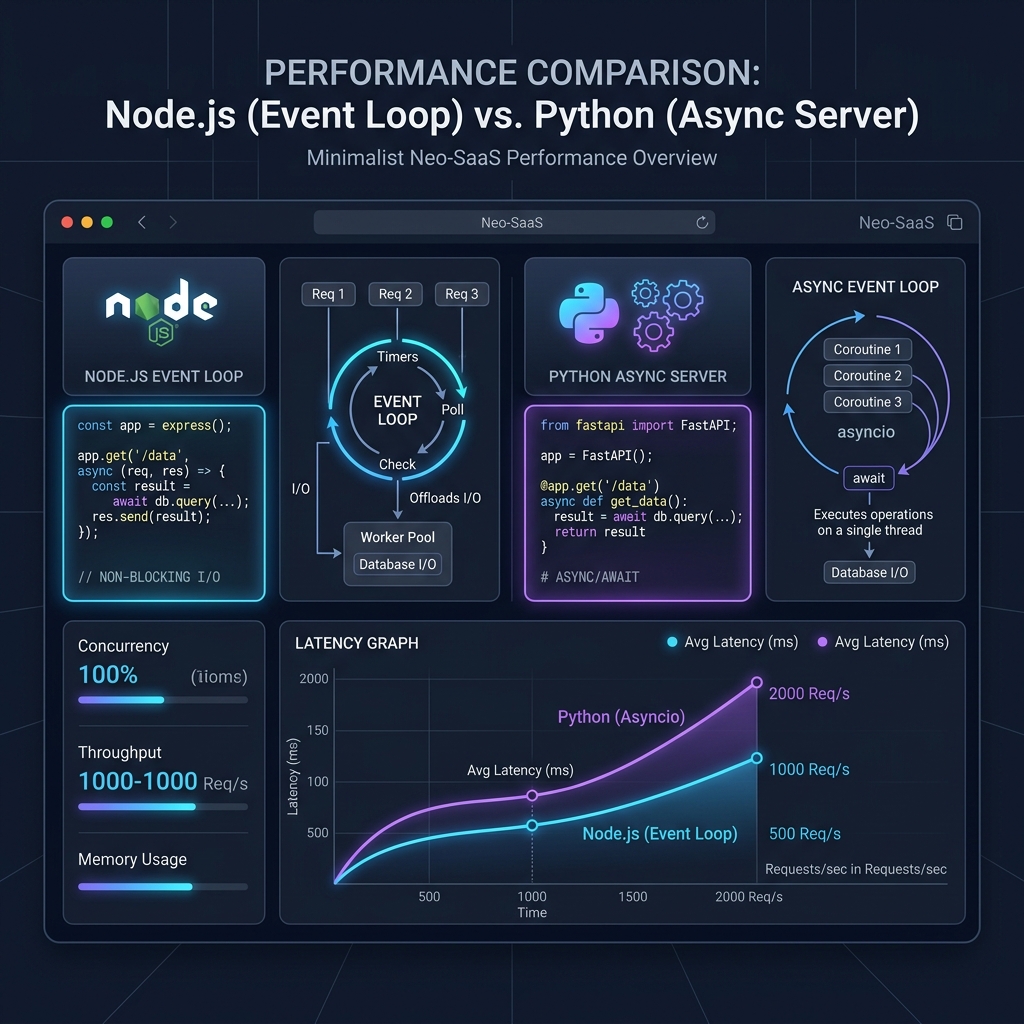
Choosing the right backend runtime dictates how efficiently your servers utilize CPU cores and RAM under high request volume. In this stress test, we compare Node.js 22 (V8 Engine) with Python 3.12 (FastAPI + Uvicorn + Gunicorn).
Test Rig Hardware & Load Generator
Both runtimes were deployed on an identical Hetzner CPX21 (3 vCPU / 4GB RAM) server instance running Linux Debian 12. We utilized autocannon to generate 10,000 concurrent HTTP GET requests returning JSON payloads.
npx autocannon -c 10000 -d 60 -m GET http://127.0.0.1:8080/api/benchmark
1. Requests Per Second (RPS) Throughput
- Node.js Fastify Server 42,400 Requests/sec 🚀
- Node.js Express Server 28,100 Requests/sec
- Python FastAPI (Uvicorn 4 Workers) 19,800 Requests/sec
- Python Django (Gunicorn WSGI) 6,400 Requests/sec
⚡ Maximize Your API Cloud Infrastructure
Deploy high-concurrency Node.js and Python microservices on high-frequency cloud servers with optimized vCPUs: